Independent review for Ireland · public sources · 19.10.2026
Eva AI: what the companion app shows, says and requires
The public presentation is emotional and cinematic. The terms are more concrete: Eva AI describes a virtual-friend chatbot using text, voice and, where available, video calls. This guide reads both surfaces together.
What is Eva AI, and what should users in Ireland check first?
Eva AI is an 18+ virtual-friend app whose published iOS terms describe text and voice chat, video calls where available, and synthetic AI-generated content. Access is divided between Basic, Premium and Neurons, but benefits and prices can vary by region and subscription length, so the live checkout matters more than an undated price quoted elsewhere. ’s privacy policy says text and voice messages may be used to improve the service and processed by external providers; treat a companion chat as personal data, not as a private diary. Eva AI
Start with the product evidence
Three public views explain the Eva AI proposition quickly
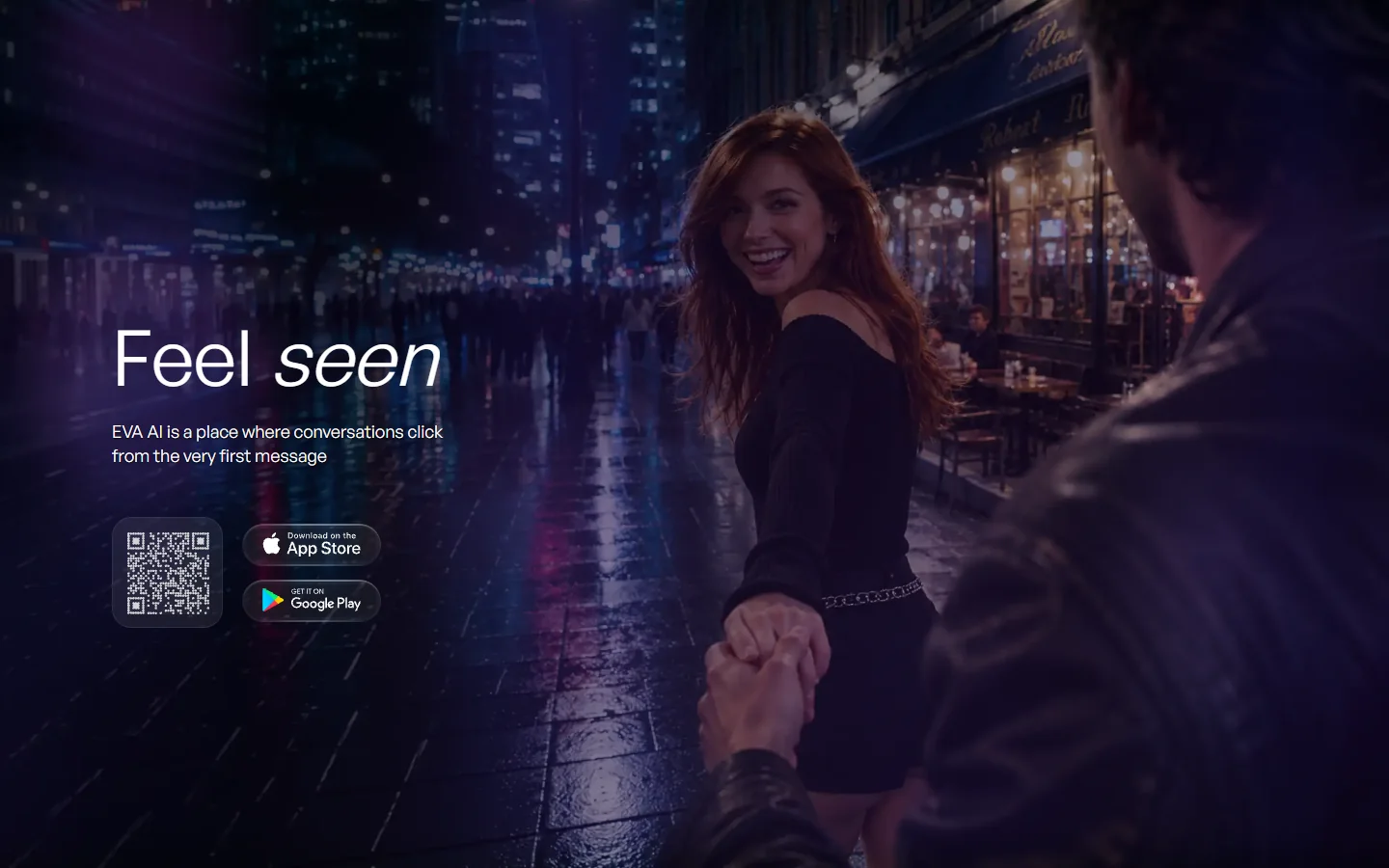
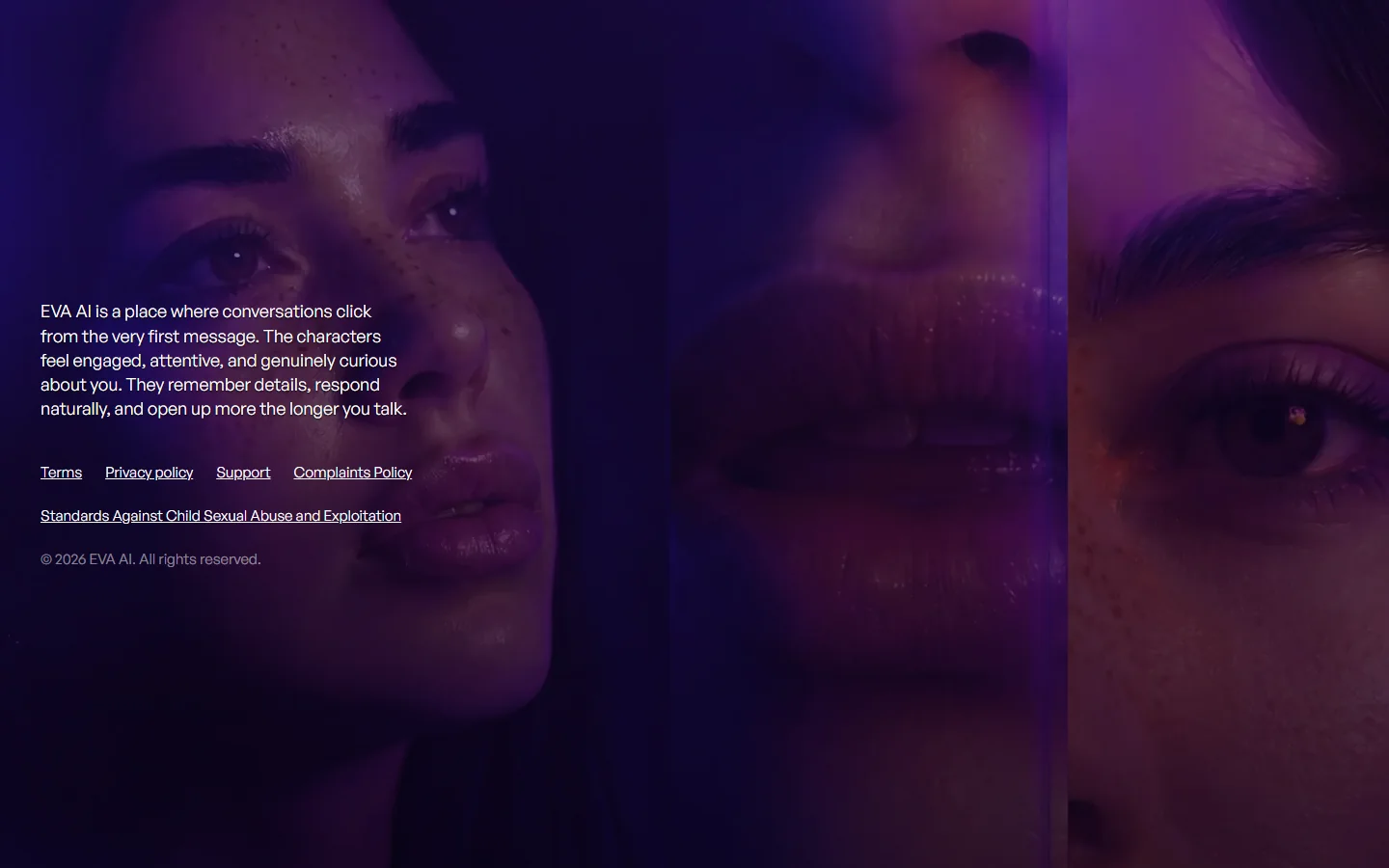
The public home leads with “Feel seen”, mobile-store badges and a cinematic companion image rather than a detailed feature list.The About page describes attentive characters, remembered details and natural replies, while still linking visitors to support and policy documents.The application examples show how EVA’s black, white and violet identity is carried into public-facing product and campaign material.
SEEN ≠ HUMAN
01 / What Eva AI is
A virtual friend presented through conversation, memory and mood
Eva AI presents itself as a companion application built around ongoing dialogue. The public home uses the line “Feel seen” and says conversations should click from the first message. The public About page expands that positioning: characters are described as engaged, attentive and curious, with responses that are intended to feel natural. It also says they remember details and open up as the conversation continues. Those statements explain the intended experience, but they should not be read as proof of human awareness or perfect memory.
The Android terms define the “Virtual friend” as an artificially intelligent simulation. They describe communication through text, voice and, where available, a video-call interface. The same terms say AI-generated content is synthetic and may not represent real people, events or interactions. That legal definition matters because the visual language deliberately borrows cues from dating, attention and closeness. The product may imitate a responsive relationship, yet the underlying interaction remains generated software.
The terms also make clear that Eva AI is not medical care, mental-health care or another professional service, and should not be used in an emergency. A companion may provide conversational structure or entertainment, but a convincing tone is not a clinical qualification. People seeking urgent or professional help should use a suitable human service instead.
02 / How it works
From account to an ongoing virtual-character conversation
01
Enter an adult service
The current Android terms state that account holders must be at least 18. They also explain that account information must be accurate and current. This age requirement comes from Eva AI’s own terms, not from the imagery used in this guide.
02
Choose or create a virtual character
The terms say users can create a virtual character by choosing or uploading relevant content. They require users to hold the necessary rights and permissions for anything uploaded, including images, and prohibit using another person’s likeness without consent.
03
Communicate across supported modes
Text and voice are explicitly named in the terms. Video calls are described as available only where supported, and may require camera and microphone permissions. The feature can be changed, suspended or discontinued, so availability should be checked in the current app.
04
Understand the access model
The terms describe Basic and Premium programmes as well as an in-app unit called Neurons. They say the exact Premium benefits appear during subscription and prices may vary by region and term. This guide therefore does not publish a fixed price or pretend every feature is included.
05
Keep expectations grounded
The terms do not guarantee accuracy, realism or suitability of AI-generated content. Treat character replies as synthetic entertainment and illustration. Check important facts elsewhere, and never assume a natural-sounding response is verified or professionally reviewed.
Every image below was captured from evaapp.ai or evaai.ai/brandbook in a clean public browser session. The files were resized for the web, not composited or generated. No OurDream media was required, so no character, model or feature from another service is attributed to Eva AI.
The home page uses a cinematic night scene, the “Feel seen” promise, a QR code and mobile-store download badges.The About page describes attentive characters, remembered details and natural responses, while keeping policy and support links visibly available.The brandbook opens with oversized white typography, deep black space and a restrained violet glow rather than app-interface chrome.The EVA signs section recommends the eye symbol and EVA AI sign in high-awareness markets, with three stated variations.The In Context area stresses contrast and consistent logo readability, then leads into separate guidance for co-branding applications.The application-examples endpoint completes the brand system and reminds viewers that use of EVA materials remains subject to terms.
04 / Reading the brandbook
What the visual system communicates before a chat begins
A
Scale creates confidence
The brandbook relies on very large, thin uppercase lettering. It makes short messages feel deliberate and premium, and it leaves enough empty space for each statement to land. This guide references that scale without reproducing the official page structure.
B
Black and violet carry the mood
Black backgrounds dominate, while violet and electric blue appear as concentrated light rather than constant decoration. The palette supports intimacy and technology at the same time. It is more restrained than a typical neon chatbot interface.
C
Contrast is a stated rule
The public brandbook explicitly links contrast to logo readability. That is why this page keeps body copy bright on dark surfaces and avoids placing the brand name over noisy screenshots. Readability is treated as a functional constraint, not just an aesthetic preference.
D
Co-branding has boundaries
The brandbook recommends the EVA AI lettering on white when a partner already uses its own symbol. This independent guide does not claim partnership or official status. It uses a separate wordmark and identifies itself as an external publication.
05 / Practical checks
What to verify before relying on Eva AI
Feature access
Confirm whether voice, video calls, images and character creation are available on your device, account and current programme. “Where available” is a real limitation in the published terms.
Permissions
Video calls may use the camera and microphone. Review device permissions and disable access you do not want to grant. Permission is a practical choice, not a requirement to trust every generated response.
Uploaded content
Only upload material you have the right to use. Do not upload another person’s image without consent, and do not ask a synthetic character to imitate a real person in a misleading way.
Payments
Read the subscription screen before purchase. The terms describe Basic, Premium and Neurons, but say benefits and prices can vary. Check renewal, cancellation and marketplace rules in the actual checkout.
Personal information
A conversational tone can encourage disclosure. Keep passwords, payment details, identity documents, workplace secrets, private health records and other people’s information outside the chat.
High-stakes support
Do not use the app as emergency, medical or mental-health care. The service’s own terms reject that role. Contact a qualified professional or emergency service when the situation requires one.
Eva AI’s public material is unusually useful because the emotional home page, concise About page, detailed terms, privacy policy and formal brandbook reveal different layers of the same product. The home explains the desired feeling. The About page describes conversational behaviour. The terms define the service, age threshold, communication modes, synthetic nature, payment structure and limits. The privacy policy explains that chat and usage data can be processed to run and improve the service. The brandbook explains how the identity should remain recognisable. Read together, they support a grounded description: is an adult virtual-character companion service built around synthetic conversation, with text and voice plus video calls where available. They do not support a promise of human understanding, flawless memory, guaranteed therapeutic benefit, absolute confidentiality or a universal fixed price. Eva AI
Common Ireland questions
Eva AI FAQ
Is Eva AI a real person or therapist?
No. Eva AI’s terms define the virtual friend as an artificial-intelligence simulation and say generated content is synthetic. The same terms say the service is not medical care, mental-health care or an emergency service. A warm or convincing reply should therefore be treated as generated conversation, not human judgement or professional advice.
Is Eva AI free, and how much does Premium cost?
The current iOS terms describe a limited Basic programme, a paid Premium programme and Neurons used for some interactions or purchases. They also say Premium benefits are defined during subscription and that prices can vary by region and term. This guide does not publish a fixed Ireland price: review the current App Store or in-app checkout, renewal period and cancellation controls before paying.
Does Eva AI need camera or microphone access?
Text and voice are named service modes, while video calls are described as available only in some cases. The terms say video calls may require camera and microphone permissions and may be changed or withdrawn. Check the permission prompt on your own device and deny access that is unnecessary for the way you intend to use the app.
Are Eva AI chats completely private?
Do not assume so. The privacy policy says text and voice messages can be collected to improve the virtual friend and may be processed with external services. It also describes usage data, analytics and optional session recordings subject to consent. Read the current policy, use deletion or access rights where applicable, and keep passwords, financial records and third-party secrets out of chat.
Can I upload any photo to create a character?
No. The terms say users are responsible for uploaded content and must have the necessary rights. They prohibit uploading images of other people without consent and prohibit deceptive likeness or impersonation uses. Use only material you own or are authorised to use, and check whether the character is marked private or public in the current interface.